Ten AI-native tools. One shared strategic memory.
Each tool reads from and writes to the same Strategic Context — the product's center of gravity. That's what makes this a suite, not ten screens.
Stratridge runs on frontier models wired to your evidence. Eight-lens audits, answer-engine probes across Perplexity and Claude, daily competitor classification, drift detection across every piece of content you ship, and drafts rewritten in your own voice — all grounded in the same store of pillars, decisions, and findings.
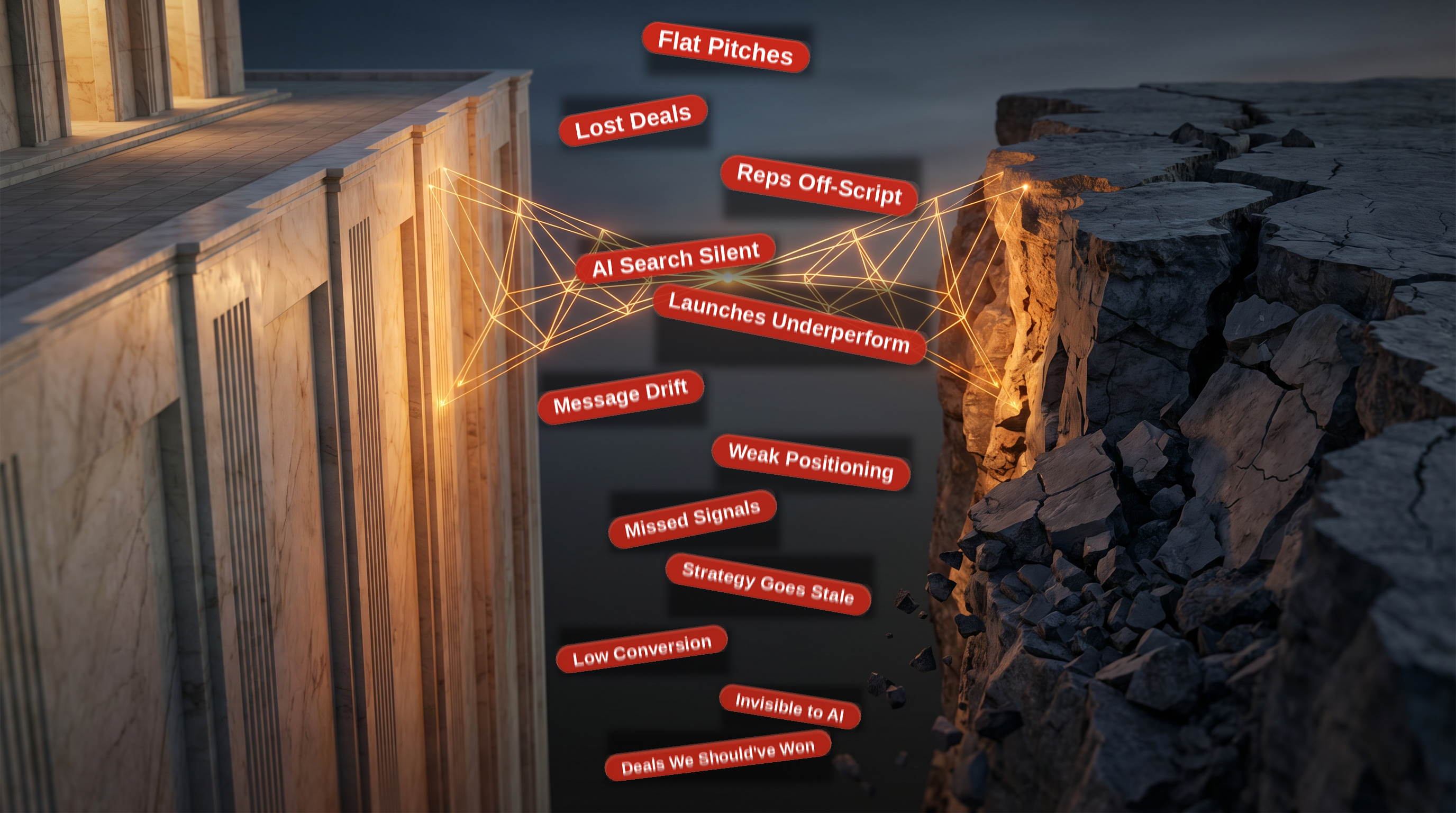
Strategic Context is the spine.
Every capability writes into a single typed store — your pillars, audits, signals, win/loss notes, decisions, and voice.
An audit finding becomes an evidence row the Analyst can cite next week. A competitor move rewrites a battle card the moment it's classified as material. A lost-deal pattern tightens the next launch's objection handling. The tools don't share a side panel — they share a brain.
Practically, that means three guarantees: findings are cited back to the quote that triggered them, drafts sound like you and not like a generic model, and the system keeps getting sharper the more of your own material it sees.
Your site, named competitors, enablement docs, win/loss notes, pillar documents, decisions.
Typed memory of pillars, evidence, signals, audit snapshots, and voice — versioned and queryable.
Audits with citations, battle cards, launch drafts, visibility fixes, grounded analyst answers.
Two tiers of capability inside the product.
The broader Stratridge practice has three tiers — diagnose, fix, and hands-on partner work. The product delivers the first two. Tier III is a retainer practice, not a feature set.
Continuous audits
Your website is the ground truth of what your company says. The suite audits it against eight lenses — plus the LLM answer surface buyers now ask first, the competitor moves that arrive every week, and the drift between what ships and what was agreed.
Remediation drafts
Every audit finding has a matched drafting tool. Rewritten hero copy, missing comparison pages, JSON-LD snippets, battle cards, launch playbooks — in your voice, grounded in your Strategic Context, ready for your editor.
Tier III — repositioning workshops, programmatic SEO builds, brand refreshes — sits outside the product. It's a retainer practice, by introduction only. Learn about the practice →
Most of this suite couldn't exist a generation of models ago.
We don't use "AI-powered" as a marketing word. We name the model behind each capability, what it's doing, and where a non-AI approach would be dishonest.
Eight-lens reasoning against your site. Each finding cites a verbatim quote and maps it to a strategic failure mode.
Probes the answer engines your buyers already use, measures citation share, and locates the site-level reasons you're absent.
Separates material moves from release-note noise. The model classifies every diff against your own positioning, not a generic taxonomy.
Reads your site, your enablement docs, and your published content. Surfaces contradictions against your pillars and flags the drift pattern.
Turns a finding into an editable first draft in your own voice. Grounded in your pillars, your tone, and the exact failure the audit surfaced.
A streaming strategy chat that answers from your audits, notes, and decisions — not the open web. Conversations persist and compound.
One loop, six stops, compounding returns.
A single audit finding doesn't die in a PDF. Here's the path it takes through the suite — and how each stop makes the next one sharper.
- 01
Evidence captured
Firecrawl renders your site exactly as a buyer (or an LLM crawler) would see it. The raw HTML and visible text land in Strategic Context as an auditable snapshot.
- 02
Finding produced
Claude reads the snapshot against your pillars through eight lenses. Each finding ships with the verbatim quote that triggered it and the strategic failure mode it maps to.
- 03
Remediation drafted
One click from the finding opens Copy Studio with the context pre-loaded — your pillars, your tone, the specific gap. First draft in your voice, ready for your editor.
- 04
Context updated
Published edits feed back in. The next audit knows what you changed. Message Consistency starts scoring your new copy against the pillar it was meant to serve.
- 05
Signal detected
A week later, Competitor Signals surfaces a rival's move. Because the finding is already in Strategic Context, the battle card updates itself with a rebuttal grounded in your position.
- 06
Analyst explains
Your team opens the Analyst to ask why the score moved. It answers from your own audit history, your decisions, and this week's signals — not the open web.
The stack, briefly.
Enough to know what you're trusting, not so much that it reads like a tech blog.
- Reasoning models
- Claude (Anthropic) — Opus for analysis, Haiku for fast triage. DeepSeek for cost-sensitive categorization.
- Answer-engine probes
- Perplexity for live web grounding. Claude and DeepSeek for non-web answer surfaces.
- Evidence capture
- Firecrawl for structured crawl of your site and named competitors.
- Application
- Next.js 15 App Router on Vercel Pro. React 19. TypeScript strict. Tailwind.
- Strategic Context store
- Neon Postgres on the HTTP driver, with versioned Drizzle migrations and a typed schema.
- Background work
- Vercel waitUntil for in-request follow-ups. Inngest for scheduled re-audits, share-link expiry, and the weekly digest.
- Delivery
- Resend for transactional and report emails. Auth.js v5 for passwordless sign-in.
Each capability has its own page — with the full feature tour.
Ten short pages, each one a working description of a single capability — inputs, outputs, and the model behind it.
Eight-lens diagnostic of your site against your own strategic intent.
How Perplexity, Claude, and DeepSeek describe you — and how to change it.
Daily monitoring of competitor moves before they become surprises.
Detects drift between your site, your reps, and your content.
Per-competitor rebuttals grounded in your own positioning.
Surfaces the real objection patterns behind deals you didn't win.
Evidence-based launch drafts built to ship, not just to present.
A living one-page doc that stays current as your market moves.
The shared memory that makes every other tool smarter over time.
AI strategy chat grounded in your own context — not generic advice.
The easiest way to see the product is to run one through your own site.
The Positioning Audit is free and public. No login, ninety seconds, a real report with evidence from your own site — and a first glimpse at how the rest of the suite builds on it.