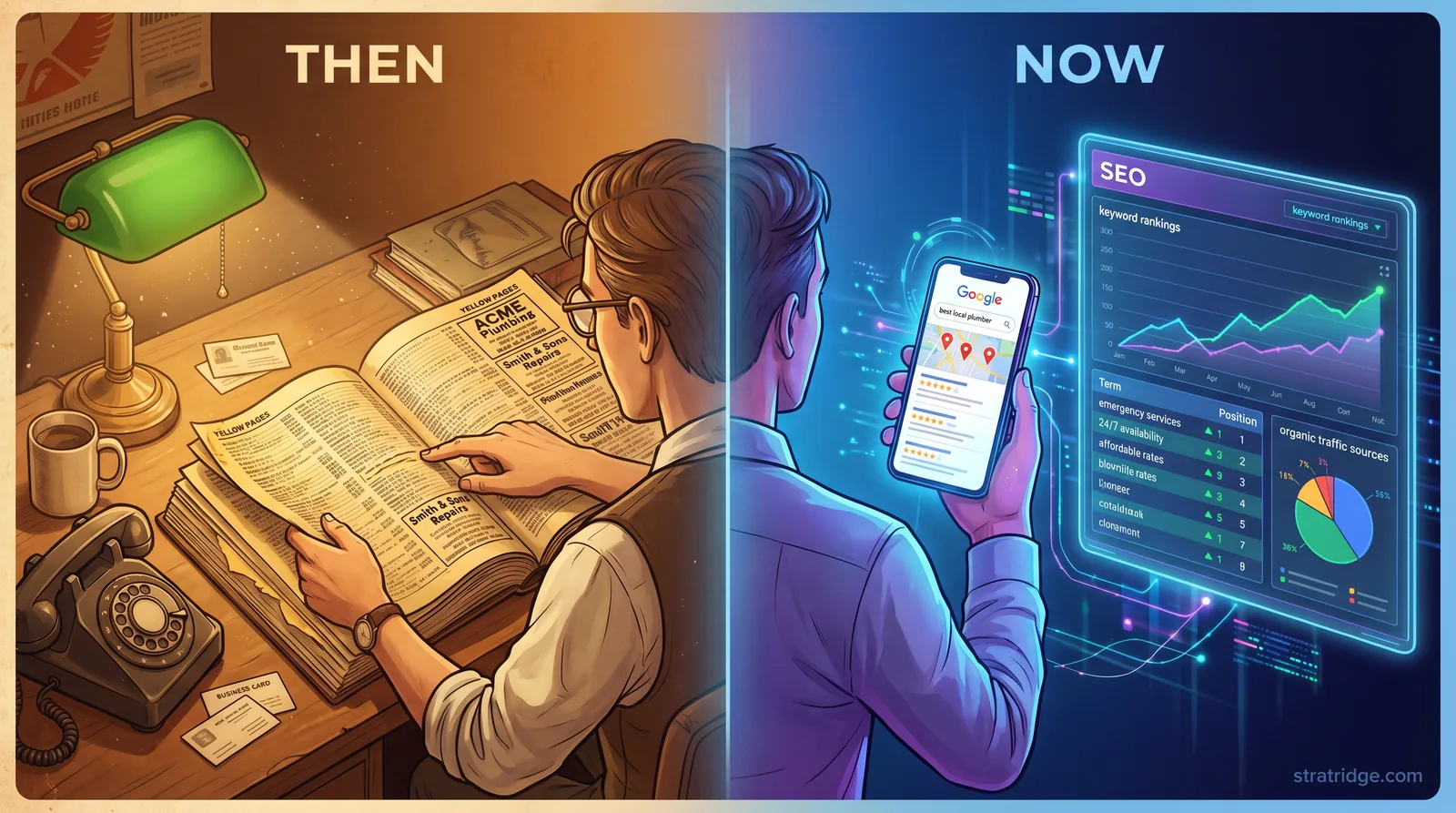
From Yellow Pages to AI-powered search intent
Key contrasts
- Directory Listings → Search Engine Optimization. Businesses paid for placement in physical directories; today, SEO determines visibility in the world's most-used information tool.
- Keyword Stuffing → Semantic Relevance. Early SEO rewarded keyword density; modern algorithms prioritize semantic relevance, authority, and user experience.
- Organic Only → Paid + Organic Integration. Search marketing began as purely organic; paid search now works in concert with SEO for maximum visibility and conversion.
- Desktop Queries → Mobile-First Search. Search was a desktop activity; the majority of searches now happen on mobile devices, reshaping intent and format.
- Text Results → Rich SERP Features. Results were once ten blue links; today's SERPs include featured snippets, knowledge panels, images, videos, and local packs.
- Keyword Research → Intent Mapping. Marketers targeted keywords; sophisticated search strategy now maps entire customer intent journeys across the purchase funnel.
- Page Ranking → Answer Engine Optimization. The goal was to rank on page one; AI-powered search now requires optimizing to be the direct answer to a query.
- Search as a Channel → Search as a Behavior. Search was one marketing channel among many; it is now a fundamental human behavior that touches every stage of the customer journey.
Why being the answer matters more than being listed
Few marketing transformations have been as consequential as the shift from physical directories to digital search. For most of the twentieth century, the Yellow Pages was the definitive tool for connecting consumers with businesses. A listing in the right category, in the right size, was a meaningful competitive advantage. The logic was simple: be findable when someone needs you.
The internet preserved this fundamental insight — intent-based discovery — while transforming everything else about it. Search engines became the new directories, and search engine optimization emerged as the discipline of earning visibility within them. The early years of SEO were characterized by technical manipulation: keyword stuffing, link schemes, and algorithmic gaming that rewarded quantity over quality.
Paid search — the ability to bid for placement against specific search queries — added a new dimension. Google's AdWords created an entirely new form of advertising: one where brands paid only when a user clicked, and where relevance was rewarded with lower costs. The combination of paid and organic search created a powerful, intent-driven marketing system unlike anything that had existed before.
Today, the frontier of search marketing is being reshaped once again by artificial intelligence. AI-powered search features, generative answers, and voice search are changing what it means to be 'found.' The challenge for marketers is no longer simply ranking on page one — it is becoming the authoritative, trusted answer that an AI search engine surfaces in response to a user's query.
Search marketing has evolved from static directory listings to AI-driven intent matching — making the ability to be found, and trusted, more complex and more critical than ever.
Keep reading
Then & Now: The Rise of Influencer Marketing
From celebrity endorsements to micro-influencers — how influencer marketing traded star power for trust, and reach for resonance.
Then & Now: The Evolution of Advertising Channels
From print and broadcast to programmatic and streaming — how the ad channel map fragmented, and what precision targeting actually changed.
Then & Now: The Transformation of Customer Data
From paper records to real-time AI-driven intelligence — how customer data evolved from filing cabinet to predictive engine.