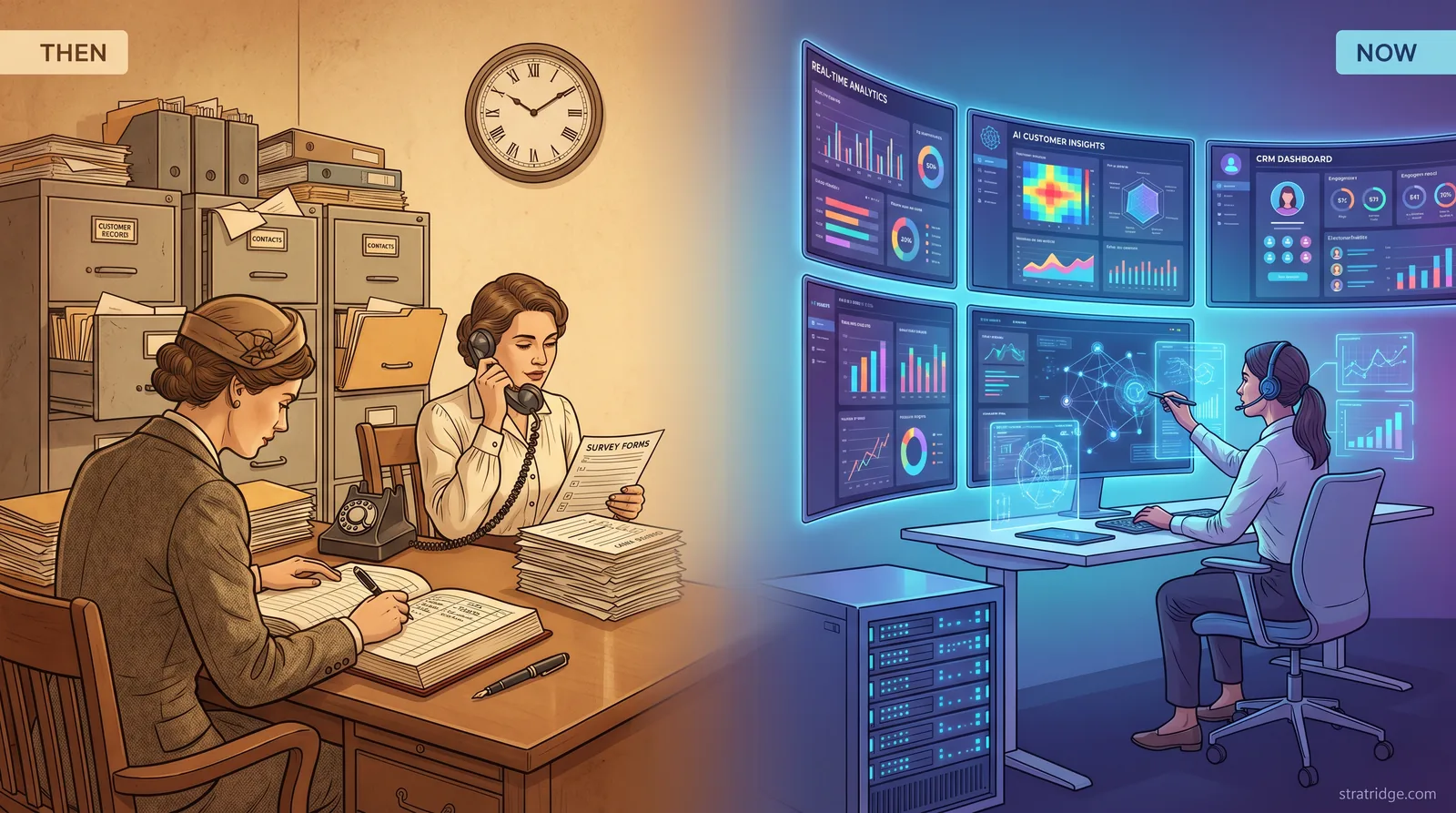
From paper records to real-time AI-driven intelligence
Key contrasts
- Filing Cabinets → Cloud Databases. Customer information once lived in physical files and ledgers; it now resides in scalable cloud platforms accessible globally.
- Periodic Surveys → Continuous Listening. Brands gathered feedback through infrequent surveys; social listening and behavioral data now provide a continuous stream of insight.
- Demographic Profiles → Behavioral Personas. Customers were defined by age and geography; they are now understood through rich behavioral, psychographic, and intent data.
- Manual Analysis → AI-Powered Insights. Analysts spent weeks interpreting data manually; machine learning now surfaces patterns and predictions in real time.
- Siloed Records → Unified Customer Profiles. Data once sat in disconnected systems; CDPs and CRMs now unify every customer touchpoint into a single coherent view.
- Reactive Decisions → Predictive Action. Marketers reacted to past behavior; predictive analytics now enables proactive engagement before a customer signals intent.
- Data Scarcity → Data Abundance. The challenge was once finding enough data; today the challenge is filtering signal from noise in an ocean of information.
- Privacy Afterthought → Privacy-First Design. Data collection once operated with minimal oversight; privacy regulation and consumer expectations now demand responsible stewardship.
Why the signal outgrew the spreadsheet
Customer data has always been the foundation of effective marketing, but the nature, volume, and application of that data have changed so dramatically that the two eras are barely comparable. In the pre-digital age, knowing your customer meant maintaining a physical file — a record of purchases, a handwritten note about preferences, perhaps a mailing address for a seasonal catalog.
The digital era created an explosion of customer data. Every website visit, every email open, every social media interaction, every purchase generates a data point. The challenge shifted from data scarcity to data abundance — and then to the far more complex problem of making sense of it all. Customer Data Platforms emerged to unify these fragmented signals into coherent profiles, while CRM systems evolved from simple contact databases into sophisticated engines for relationship management.
Artificial intelligence has taken this further still. Machine learning models can now predict which customers are likely to churn, which prospects are ready to buy, and which messages will resonate with which segments — all in real time, at scale. The marketer's intuition has been augmented, and in some cases replaced, by algorithmic precision.
Yet this transformation carries significant responsibility. As data capabilities have grown, so too have consumer expectations around privacy and transparency. The brands navigating this era most successfully are those that treat customer data not as a resource to be extracted, but as a trust to be honored — using insight to serve customers better, not merely to sell to them more aggressively.
Customer data has evolved from sparse paper records to rich, real-time intelligence — reshaping how brands understand, predict, and serve their audiences.
Keep reading
Then & Now: The Rise of Influencer Marketing
From celebrity endorsements to micro-influencers — how influencer marketing traded star power for trust, and reach for resonance.
Then & Now: The Evolution of Advertising Channels
From print and broadcast to programmatic and streaming — how the ad channel map fragmented, and what precision targeting actually changed.
Then & Now: The Transformation of Market Research
From focus groups and surveys to real-time social intelligence — how market research traded scheduled studies for continuous signal.