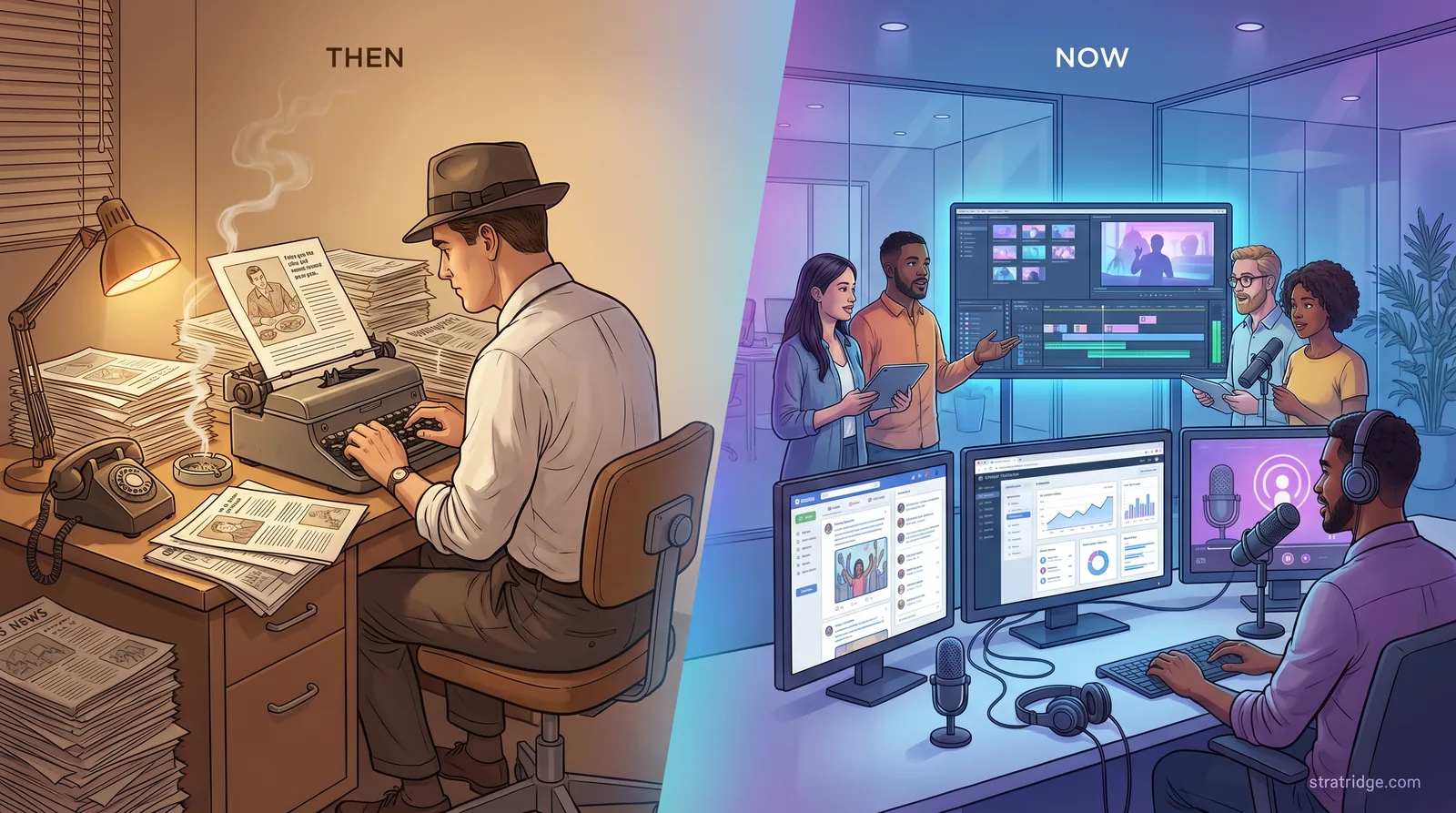
From the single big campaign to always-on content
Key contrasts
- The Big Idea → the Content Engine. Brands once built entire years around a single campaign concept; today, storytelling is a continuous, multi-format operation.
- Agency-Led → In-House Creation. Creative work was outsourced to advertising agencies; many brands now operate sophisticated in-house studios and content teams.
- Seasonal Campaigns → Evergreen Narratives. Marketing once followed seasonal rhythms; digital storytelling demands a persistent brand narrative across all touchpoints year-round.
- Product Features → Brand Values. Advertising once led with product attributes; modern brand storytelling leads with purpose, values, and cultural relevance.
- Passive Audience → Active Participants. Consumers once received brand stories; today they co-create them through reviews, social content, and community participation.
- TV as Primary Canvas → Multi-Platform Storytelling. The TV commercial was the pinnacle of brand storytelling; today stories unfold across video, audio, text, and interactive formats simultaneously.
- Controlled Narrative → Authentic Dialogue. Brands once controlled their story completely; social media has made brand narrative a conversation, not a monologue.
- Emotional Manipulation → Genuine Connection. Advertising once engineered emotional responses; audiences now demand stories that reflect genuine brand behavior and values.
Why the always-on era rewrote the rules
Brand storytelling has always been at the heart of great marketing, but the craft, cadence, and canvas have been fundamentally transformed. The golden age of advertising was defined by the 'big idea' — a single, powerful campaign concept that a brand would build an entire year around. These campaigns were expensive to produce, carefully controlled, and designed to make an emotional impact through repetition across a handful of mass-market channels.
The digital era shattered this model. Audiences fragmented across dozens of platforms, attention spans shortened, and the expectation of constant, relevant content created pressure that no annual campaign could satisfy. Brands had to become publishers — maintaining a continuous stream of stories, perspectives, and conversations that kept them present and relevant in their audiences' daily lives.
This shift demanded new organizational capabilities. In-house content studios, editorial calendars, social media teams, and video production capabilities became standard infrastructure for marketing departments that once simply briefed external agencies. The speed of content creation accelerated dramatically, bringing both opportunity and risk — the opportunity to be timely and culturally relevant, and the risk of saying the wrong thing in the wrong moment.
Perhaps most significantly, the relationship between brand and audience in storytelling has become genuinely reciprocal. Consumers are no longer passive recipients of brand narratives; they are active participants who share, remix, critique, and amplify brand stories. The brands that understand this — that their story is co-authored by their community — are the ones building the most durable relationships in the modern marketing landscape.
Brand storytelling has evolved from the controlled, seasonal big campaign to a continuous, multi-platform dialogue shaped as much by audiences as by brands themselves.
Keep reading
Then & Now: The Evolution of Brand Identity
From static logos to living, dynamic brand systems — how brand identity shifted from a style-guide artifact to an operating system.
Then & Now: The Change in Email Marketing
From batch-and-blast to intelligent personalization — how email survived every eulogy and became one of marketing's sharpest channels.
Then & Now: The Shift in Customer Engagement
From call centers to omnichannel experience orchestration — how customer engagement turned from cost center into loyalty engine.