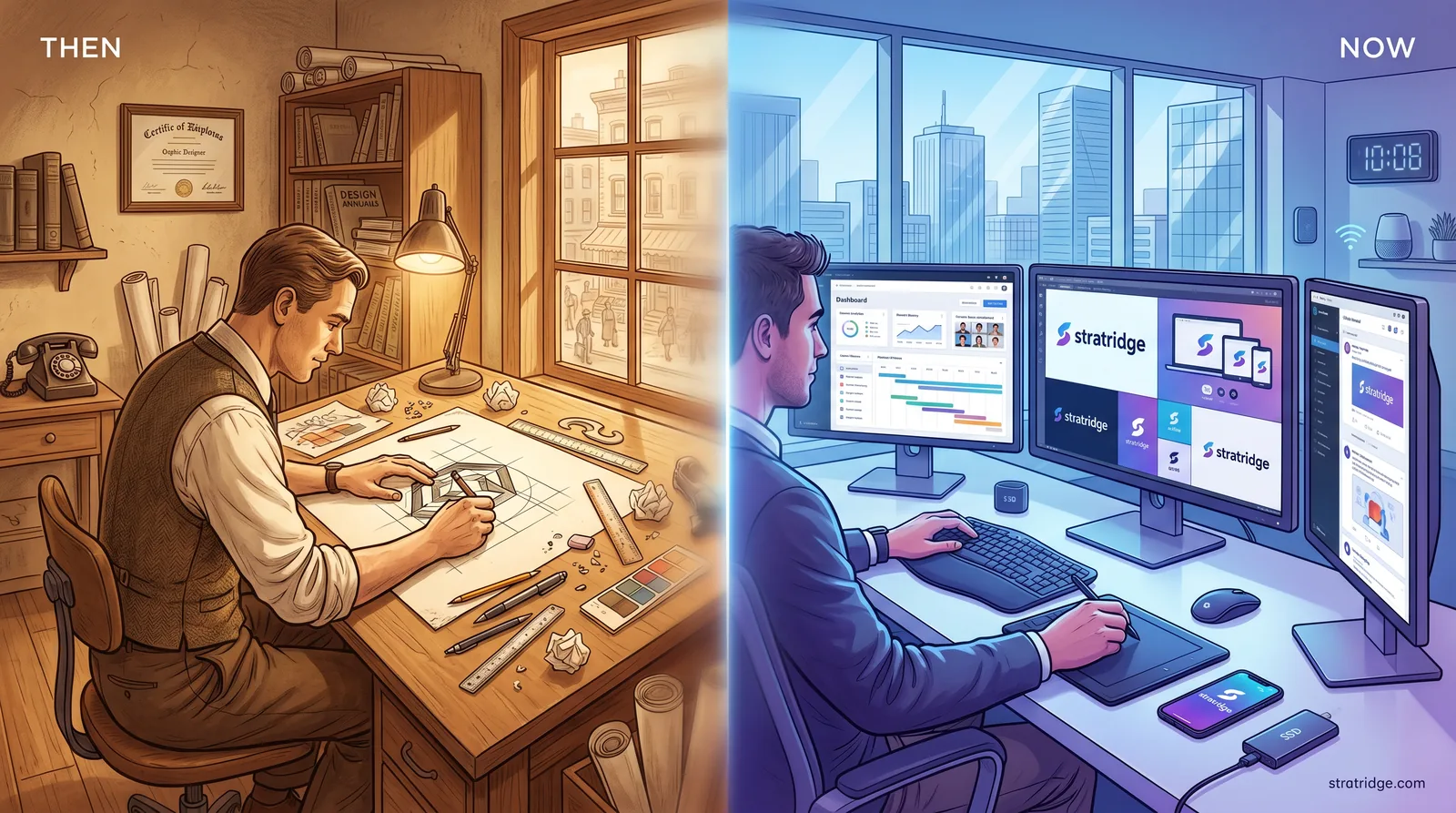
From static logos to living, dynamic brand systems
Key contrasts
- Static Logos → Dynamic Identity Systems. A brand was once a fixed logo applied consistently; today, leading brands operate flexible identity systems that adapt across contexts.
- Print-First → Screen-First Design. Brand identity was designed for print reproduction; digital-first design now prioritizes how a brand appears on screens of every size.
- Manual Style Guides → Digital Brand Management. Thick printed style guides governed brand usage; cloud-based brand management platforms now ensure consistency at scale.
- Designer-Controlled → Democratized Creation. Brand assets were created by specialist designers; today, self-serve tools allow teams across the organization to create on-brand content.
- Logo as Brand → Experience as Brand. The logo was once the primary expression of brand identity; today, every customer touchpoint is a brand expression.
- Timeless Design → Culturally Responsive Identity. Brands sought timeless visual identities; modern brands update their identity to remain culturally relevant and responsive.
- Single Market → Global-Local Identity. Brand identity was designed for a single market; global brands now manage identities that must work across diverse cultural contexts.
- Brand as Asset → Brand as Culture. Brand identity was treated as a corporate asset; the most powerful brands today are cultural phenomena shaped by their communities.
Why systems outlasted style guides
Brand identity has always been about recognition and differentiation — the visual and verbal shorthand that tells a customer who you are and what you stand for. For most of the twentieth century, this meant a carefully designed logo, a defined color palette, a set of approved typefaces, and a thick manual governing how all of these elements could and could not be used. The goal was consistency, and consistency was achieved through control.
The digital era complicated this model in productive ways. A brand identity designed for a newspaper advertisement or a printed package now had to work on a smartphone screen, a social media profile, a website, a digital billboard, and an app icon — each with different dimensions, different viewing contexts, and different audience expectations. Static identity systems struggled to adapt, and a new discipline of dynamic brand identity emerged to meet the challenge.
Today's most sophisticated brand identities are systems rather than standards — flexible frameworks that maintain coherence while allowing adaptation. Google's identity is instantly recognizable whether it appears as a full wordmark, a favicon, or an animated doodle. Nike's identity lives as much in the behavior of its athletes and the culture of its community as in the swoosh itself.
The democratization of design tools has added another dimension. When anyone in an organization can create branded content using self-serve platforms, the challenge of maintaining identity integrity becomes both more complex and more important. The brands that navigate this most successfully treat identity not as a set of rules to enforce, but as a culture to cultivate.
Brand identity has evolved from a fixed logo in a style guide to a living, adaptive system that expresses itself across every customer touchpoint and cultural moment.
Keep reading
Then & Now: The Shift in Brand Storytelling
From the single big campaign to always-on content — how brand storytelling became a year-round media operation rather than a seasonal event.
Then & Now: The Change in Email Marketing
From batch-and-blast to intelligent personalization — how email survived every eulogy and became one of marketing's sharpest channels.
Then & Now: The Shift in Customer Engagement
From call centers to omnichannel experience orchestration — how customer engagement turned from cost center into loyalty engine.