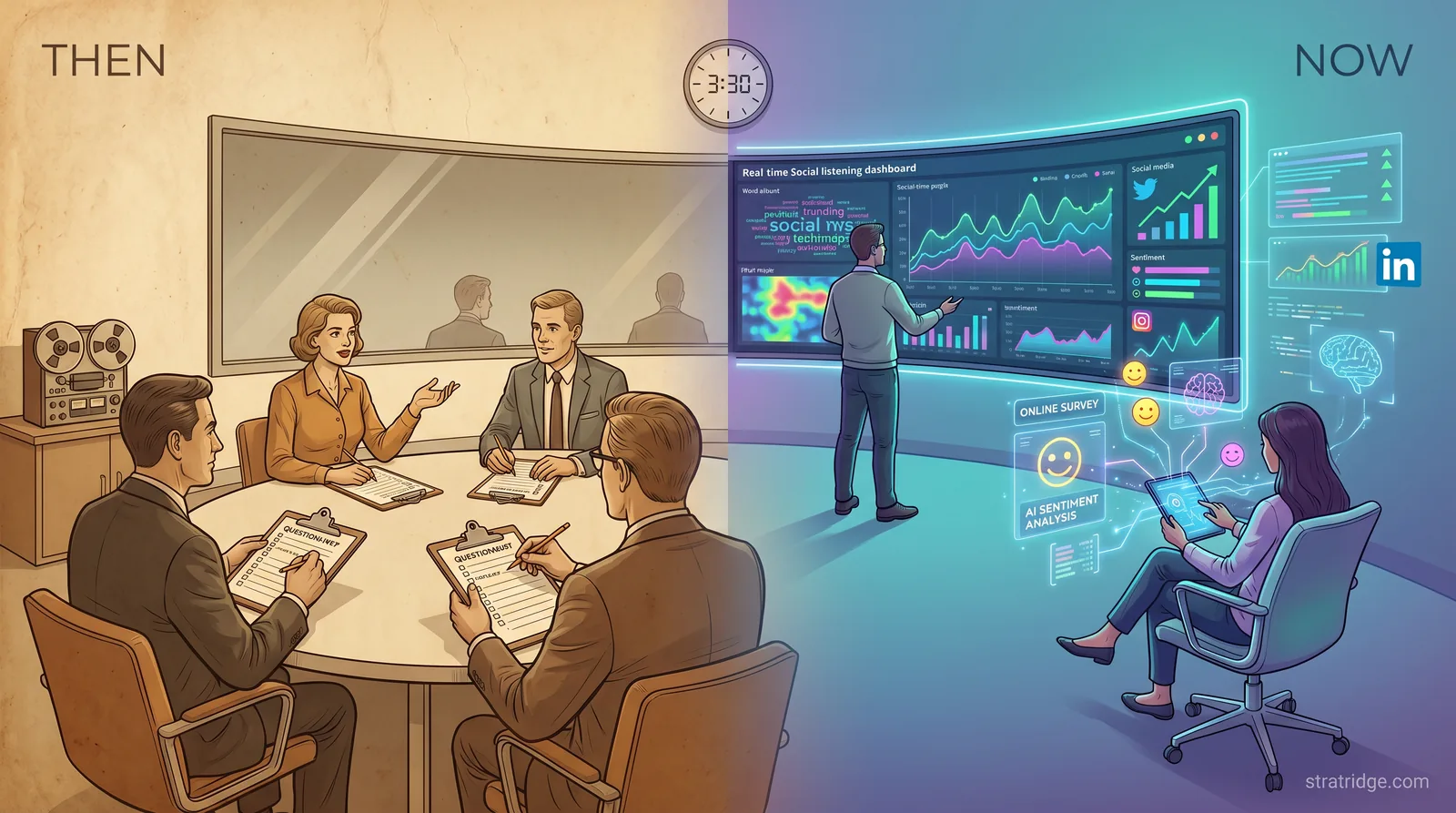
From focus groups and surveys to real-time social intelligence
Key contrasts
- Focus Groups → Social Listening. Controlled focus group sessions have been supplemented by always-on social listening that captures organic consumer sentiment at scale.
- Periodic Surveys → Continuous Feedback. Annual or quarterly surveys have given way to continuous feedback loops through digital touchpoints and community platforms.
- Small Samples → Big Data. Research once relied on statistically representative samples; digital data now enables analysis of entire customer populations.
- Weeks → Results to Real-Time Insight. Traditional research took weeks to yield findings; digital tools surface insights within hours or even minutes.
- Stated Preferences → Revealed Behavior. Surveys captured what people said they would do; behavioral data captures what they actually do — a far more reliable signal.
- Expensive Agencies → Democratized Tools. Market research was the domain of specialist agencies; self-serve platforms have democratized access to consumer insight.
- Reactive Research → Predictive Intelligence. Research answered questions about the past; AI-powered tools now predict future consumer behavior and emerging trends.
- Isolated Studies → Integrated Intelligence. Research projects were one-off exercises; modern insight functions integrate data continuously into marketing decision-making.
Why continuous beats periodic
Market research has always been the compass of marketing strategy — the means by which brands attempt to understand who their customers are, what they want, and why they behave as they do. For most of the twentieth century, this understanding was built through carefully designed studies: focus groups convened in sterile rooms behind one-way mirrors, telephone surveys administered by trained interviewers, and written questionnaires distributed to carefully selected samples.
These methods had genuine value but significant limitations. They were expensive, time-consuming, and subject to the well-documented gap between what people say they will do and what they actually do. The focus group became a target of criticism for its susceptibility to groupthink, social desirability bias, and the distorting influence of dominant personalities.
Digital technology transformed the research landscape in two fundamental ways. First, it created an unprecedented volume of behavioral data — every search query, every purchase, every social media post is a revealed preference, far more reliable than a stated one. Second, it created tools that could analyze this data at scale and speed that no traditional research method could match.
Social listening platforms now monitor millions of conversations in real time, surfacing emerging trends, sentiment shifts, and competitive intelligence continuously. AI-powered analytics can identify patterns in consumer behavior that no human analyst would have the capacity to detect. The result is a research function that is faster, richer, and more integrated into marketing decision-making than ever before.
Market research has evolved from periodic, sample-based studies to continuous, behavior-driven intelligence — giving brands an unprecedented window into consumer reality.
Keep reading
Then & Now: The Rise of Influencer Marketing
From celebrity endorsements to micro-influencers — how influencer marketing traded star power for trust, and reach for resonance.
Then & Now: The Evolution of Advertising Channels
From print and broadcast to programmatic and streaming — how the ad channel map fragmented, and what precision targeting actually changed.
Then & Now: The Transformation of Customer Data
From paper records to real-time AI-driven intelligence — how customer data evolved from filing cabinet to predictive engine.